
Evolving for Today’s Workforce Reality
What started as a solution focused on helping manufacturers fill difficult-to-staff general labor roles has continued to evolve as workforce needs have changed.
Today, companies have fewer ready-to-go candidates locally, and the ones they can find are competing with larger employers or have skill gaps. They need access to specialized talent, faster hiring timelines, and flexible workforce models. That evolution has led KFI Workforce Solutions to expand beyond traditional staffing and into global workforce solutions.
While our foundation remains rooted in manufacturing and workforce expertise, we now connect organizations with highly skilled professionals across manufacturing support, IT, engineering, customer service, administrative roles, finance, sales support, and other specialized functions. KFI Workforce Solutions isn’t changing who we are – we’re expanding what we can do for our partners without geographical limitations.
Our Business is Growing
Our team finds qualified talent worldwide and brings them to you for your specialized roles. We handle the sourcing, vetting, and placement so you get the right people without the global recruitment headache. We specialize in contract-based recruitment, handling the full process from candidate sourcing and screening to final placement. Our expertise begins in manufacturing and off-site roles, but extends to IT, professional services, administrative support, and other specialized positions. We drive increased retention, reduced turnover, and boost overall productivity.
KFI Workforce Solutions was built from firsthand experience. Our team saw the challenges businesses faced every day – labor shortages, high turnover, increasing competition for talent, and the constant pressure to keep operations moving.
Expanding Your Talent Pool Globally
Global recruitment is no longer just about cutting costs, it’s about expanding access to skilled, dependable talent. Our global professionals are carefully sourced, vetted, and matched to your company’s needs – acting as an extension of your local team.
While national job opening numbers have shown modest improvement since their 2022 peak, the reality for small and mid-size businesses in America tells a completely different story. As of November 2025, 33% of small business owners reported job openings they could not fill.
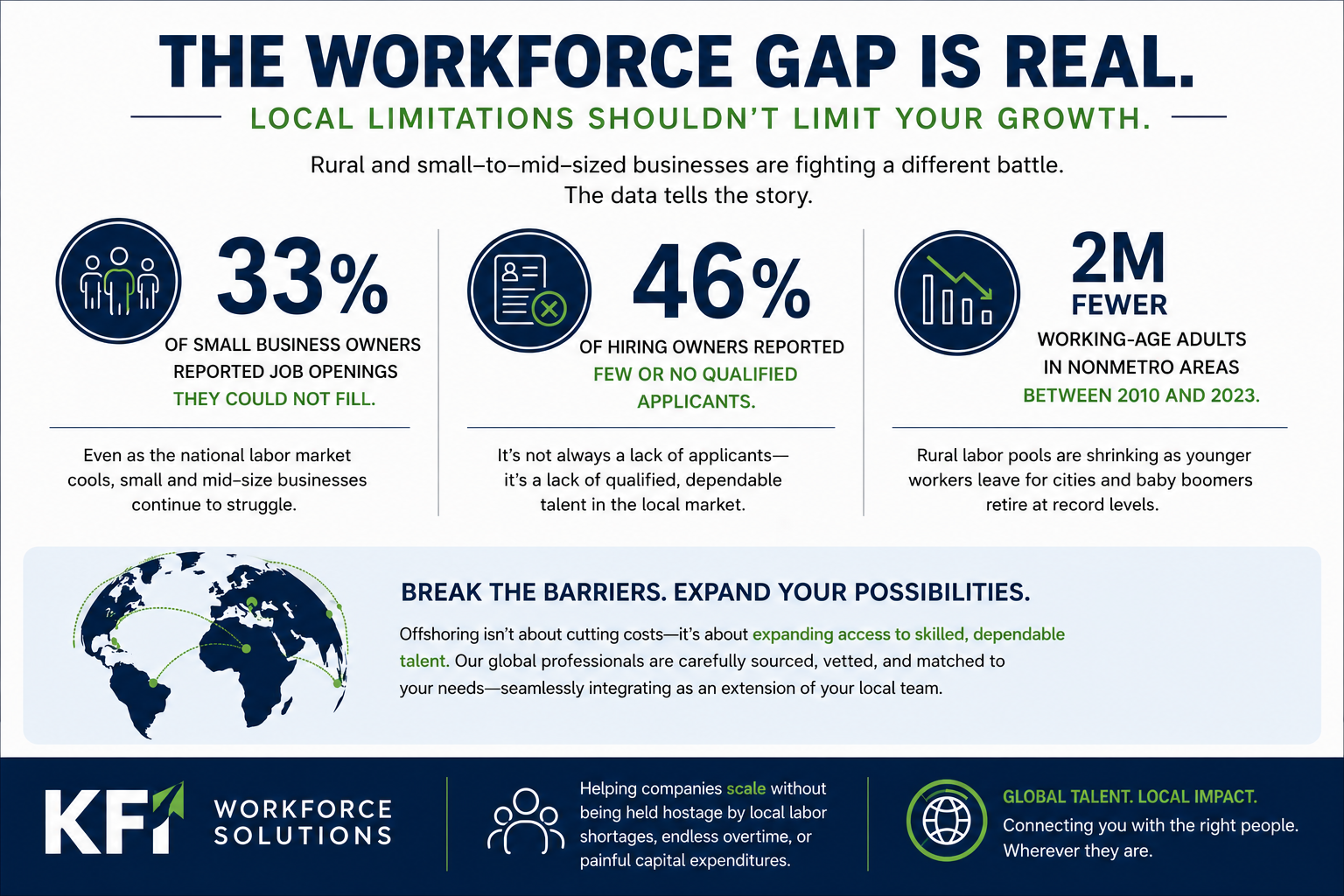
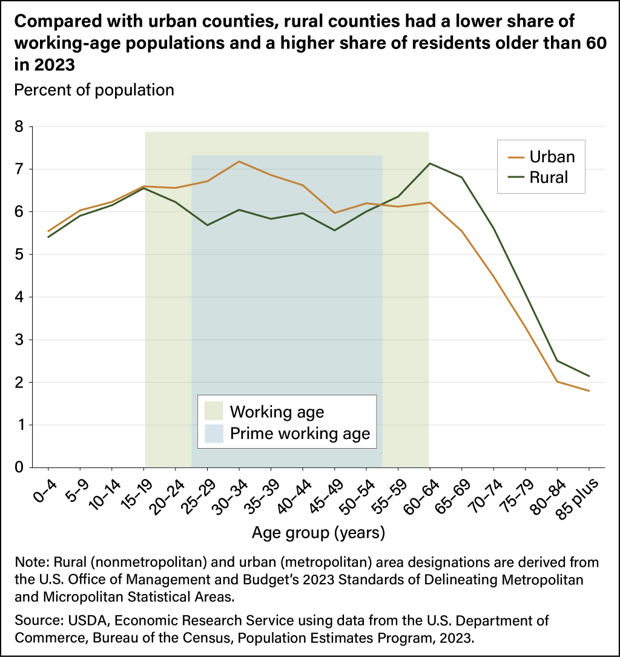
Between 2010 and 2023, the number of working-age adults between 15 and 64 declined steadily in nonmetropolitan areas. This is the result of younger workers leaving for cities, combined with one of the most significant baby boomer retirement waves in American history. This leaves middle and back-office positions hard to find for employers.
In a labor market defined by rapid economic, geopolitical, and technological change, employers are reluctant to make long-term bets.
Ready to Expand Your Talent Search?
If your middle or back-office roles have been open for months and the local talent pool keeps coming up short, it might be time to have a different conversation. Reach out to us and let’s take a look at what you’re trying to fill, where you’re stuck, and whether an outsourcing solution makes sense for your operation.
Sources
- Stat 1 & the historical average: “NFIB Jobs Report: Owners Continue Searching for Qualified Applicants.” National Federation of Independent Business, 4 Dec. 2025, www.nfib.com/news/press-release/nfib-jobs-report-owners-continue-searching-for-qualified-applicants/.
- Stat 2 — Worker Shortage Index: “America Works Data Center: The U.S. Workforce by the Numbers.” U.S. Chamber of Commerce, www.uschamber.com/workforce/america-works-data-center. Accessed 18 May 2026.”Understanding America’s Labor Shortage: The Most Impacted States.” U.S. Chamber of Commerce, www.uschamber.com/workforce/the-states-suffering-most-from-the-labor-shortage. Accessed 18 May 2026.
- Stat 3 — Rural skills gap: “Understanding America’s Labor Shortage.” U.S. Chamber of Commerce, www.uschamber.com/workforce/understanding-americas-labor-shortage. Accessed 18 May 2026.
- Stat 4 —“Population & Migration.” Economic Research Service, United States Department of Agriculture, www.ers.usda.gov/topics/rural-economy-population/population-migration. Accessed 18 May 2026